Vitamin D vs Sunlight Exposure and Aging | HealthSpan Quest
The Pill In Your Cabinet Is Doing About A Third Of The Job
You have been told the same thing for twenty years. Wear sunscreen. Stay out of the sun. Take a vitamin D supplement to cover the difference.
For two generations that script has been treated as settled science. It is not.
Vitamin D and sunlight are not the same intervention, and quietly swapping one for the other is how a whole cohort of careful, health conscious professionals ended up deficient, flat, and worse off than the neighbor who mows his lawn without a shirt on. Sunlight is the fifth of the ten levers in the 10 Pillars of Healthspan, and the one where the official advice and the actual research have drifted furthest apart.
Where The Script Came From
If you grew up near a beach in the 70s, the routine was baby oil and a foil reflector. Then the Australians ran "Slip, Slop, Slap," the melanoma data got loud, and the pendulum swung the whole way across in about fifteen years.
What came out the other side was simple, which is why it stuck. Sun causes skin cancer. Avoid sun. Avoiding sun makes you deficient. So take a pill.
Every link has a kernel of truth. The chain is still wrong.
What The Supplement Actually Buys You
Let me be fair to the pill first, because I take one and I recommend one.
Vitamin D3, taken with K2 and adequate magnesium, will reliably raise your serum 25(OH)D into range inside two or three months. Bone density, immune function, hormone production, mood. Most adults over 40 run below optimal, and some run below optimal while supplementing, because the form, the dose, or the absorption is off. Correcting a real deficiency is worth doing.
Here is where it gets uncomfortable.
The VITAL trial is the biggest test anyone has run on this. Randomized, placebo controlled, 25,871 participants (men 50 and older, women 55 and older, all free of cancer and cardiovascular disease at baseline), 2,000 IU of D3 a day, roughly five years of follow up, published in the New England Journal of Medicine in 2019 (read the paper).
No reduction in cancer incidence. No reduction in major cardiovascular events. There was a signal on cancer mortality in later analyses that is worth watching, but the primary endpoints came back flat.
That is not an argument against vitamin D. It is an argument against the assumption that vitamin D is what sunlight was doing for you. Different claims, and people collapse them constantly.
Vitamin D is one output of a machine with six. You can buy that one in a bottle for eleven dollars. The other five are not for sale.
The Swedish Number I Tried Hard To Throw Out
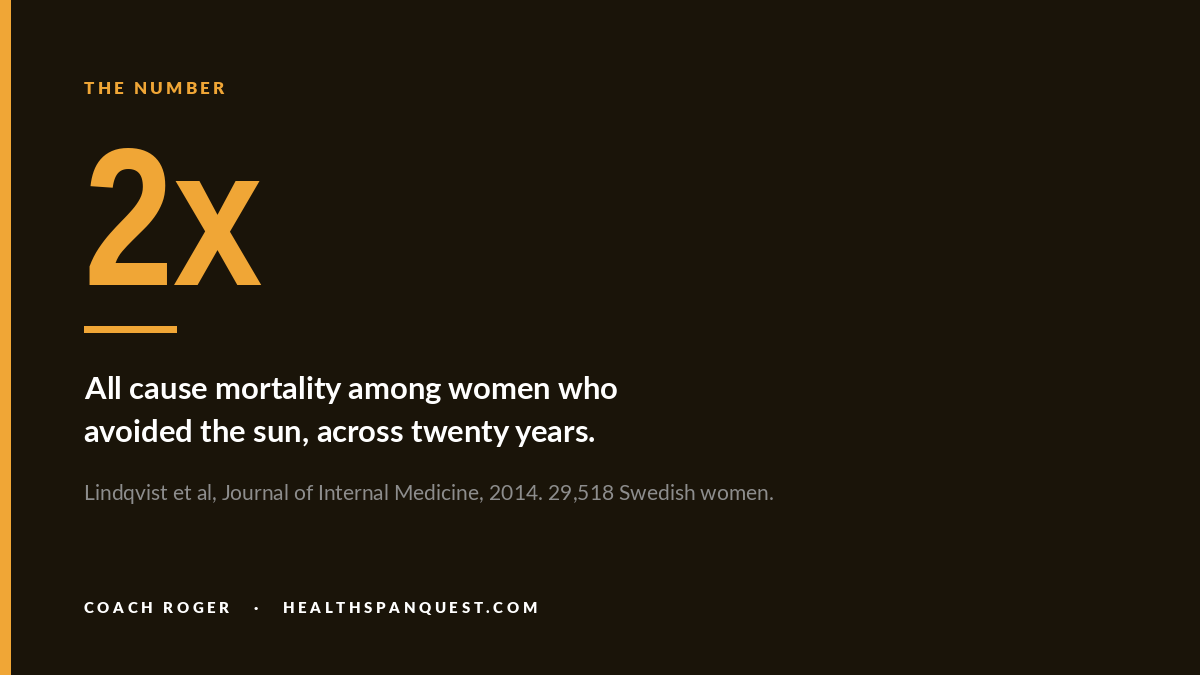
In 1990 to 1992, researchers enrolled 29,518 Swedish women aged 25 to 64 into the Melanoma in Southern Sweden cohort and followed them for twenty years. Lindqvist and colleagues published the mortality analysis in the Journal of Internal Medicine in 2014. There were 2,545 deaths.
Women who avoided sun exposure died at roughly twice the rate of the women with the highest sun exposure (read the paper).
The 2016 competing risk follow up sharpened it. The excess sat mainly in cardiovascular death. And the line that stopped me cold: nonsmokers who avoided the sun had a life expectancy similar to smokers in the highest sun exposure group (read the follow up).
I read that paper the first time looking for a reason to bin it. It contradicted what I had been telling clients for a decade, and a finding that convenient deserves a hard look.
Honest read. It is observational, it is Swedish women at high latitude, and the confounding is obvious to anyone who thinks about it for thirty seconds: people who sunbathe take vacations, and people who take vacations have money, time, and lower stress loads. Sun exposure may partly be a marker for a life that is going well.
What survives all of that is a twenty year follow up, an effect size that is not subtle, and a direction that lines up with the mechanistic work. That last part is the one I could not argue away.
You are not declining. You are under-optimized, and in this case you are under-optimized because you followed public health advice written in 1994 with more confidence than the evidence supported.
The Mechanisms A Capsule Cannot Copy
Nitric oxide. This is the big one and almost nobody knows about it. Your skin stores nitrogen oxides in a light-sensitive form. UVA releases them, the arterial system dilates, blood pressure drops. Liu and colleagues showed this in 24 healthy volunteers in the Journal of Investigative Dermatology in 2014: two standard erythemal doses of UVA to the skin, blood pressure down, and it happened independently of nitric oxide synthase, meaning it came out of a stored reserve rather than being manufactured on demand (read the research).
Your skin is a nitric oxide tank. Sunlight is the valve. No capsule touches the valve.
Beta-endorphin. UV on skin triggers beta-endorphin release, which is a real part of why a sunny morning changes your mood by 9am. It runs independently of vitamin D status, so a man with a perfect 55 ng/mL and no sun exposure gets none of it.
Circadian setting. Light through the retina, not the skin, sets your 24 hour hormonal cycle. Cortisol curve, melatonin onset, core temperature, appetite. Full protocol is in the morning sunlight piece, and it pairs with what deep sleep does to growth hormone, covered in why sleep is the most underrated anti-aging tool. No pill participates in any of this.
Red and near infrared signaling. Sunlight carries a large red and near infrared fraction that appears to act on mitochondria directly. Promising rather than established. The device marketing has run four years ahead of the evidence.
My Own Number, And What Actually Moved It
Through my late 30s and into my 40s I ran the standard playbook. SPF 50 every morning. Long sleeves. Shade. Nineteen years in a diesel shop had not made sunlight a daily feature anyway, and after the L5/S1 fusion at 34 I was not outdoors much regardless.
February 2016, mid winter, I pulled a full panel. My 25(OH)D came back at 23 ng/mL. I had been taking 2,000 IU of D3 daily for two years at that point.
Twenty-three. On a supplement. That was the morning I stopped assuming the pill had it covered.
What changed was not the dose. Magnesium glycinate, K2, the capsule moved to a meal with actual fat in it, and deliberate midday sun on bare arms and back three to five days a week from April through September. Fifteen to thirty minutes. Never to redness. Hat on the whole time.
By September my level was 58. My resting systolic came down about eight points over the same stretch, which I did not connect to sunlight until I read the Liu paper two years later. The following February was the best winter mood I had had in years.
I run Thorne D3/K2 liquid drops. Five in the winter, two or three in the summer. Not sponsored, that is just what sits in my cabinet next to the magnesium.
A client of mine, 61, commercial pilot, close to the worst possible occupation for this. Pressurized tube, no UVB, four time zones a week. He came in at 19 ng/mL with fatigue he had written off as the job. Fourteen weeks on the protocol below. He came back at 51 ng/mL, systolic from 138 to 124. What he mentioned first was not energy. It was that he stopped dreading February.
I did not accept the simplified script. I designed my way out of it.
The Seven Steps, In The Order I Run Them
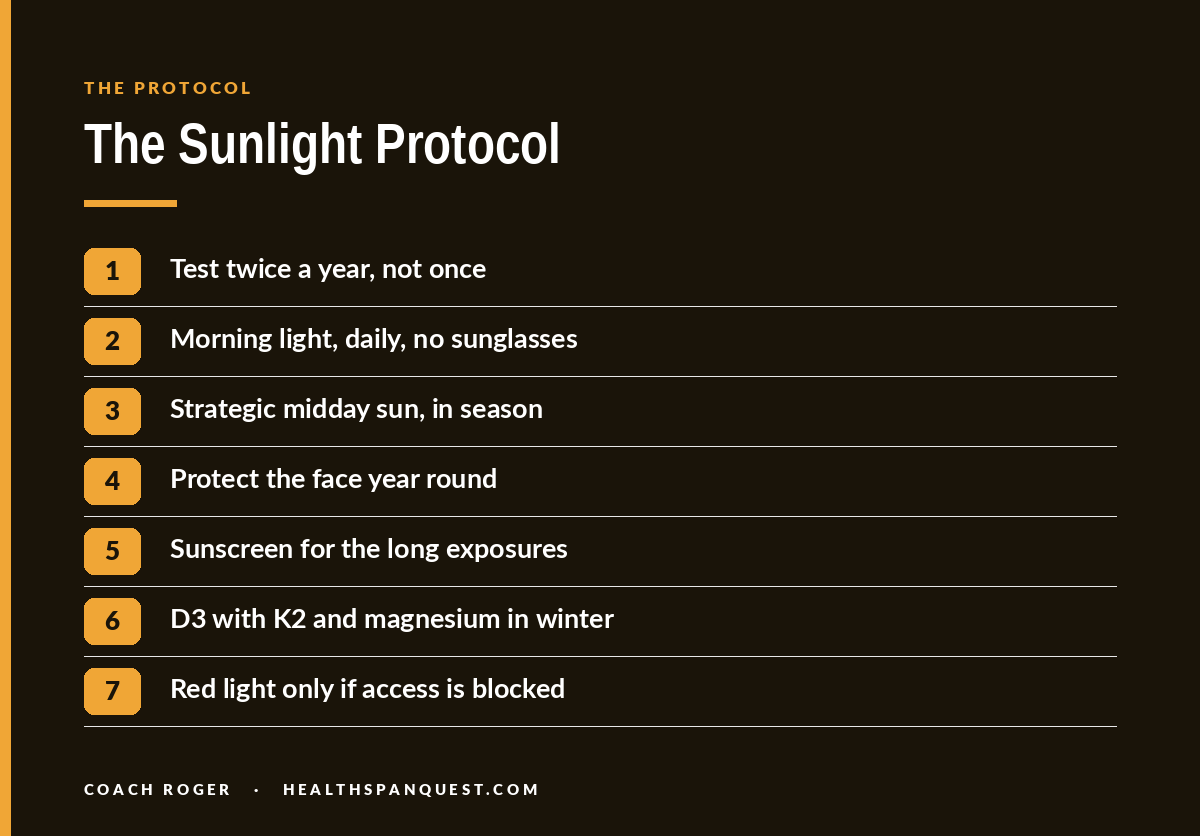
1. Test twice a year, not once. Late winter is your floor, late summer is your ceiling. A June test tells you almost nothing about the version of you that exists in February.
2. Morning light, daily, ten to twenty minutes, no sunglasses. Outside within thirty minutes of waking. This is the circadian lever and it has nothing to do with vitamin D. It works through cloud cover and it works in January. Full version is in the morning sunlight protocol.
3. Strategic midday sun, three to five days a week, in season. Fifteen to thirty minutes on bare arms, legs, or back. Fairer skin needs less, darker skin needs more, everyone stops well before any pink. This is the vitamin D and nitric oxide lever, and at most northern latitudes it goes dormant from late October through early March because there is effectively no UVB reaching the ground.
4. Protect the face year round. Hat, shade, or sunscreen, every day, no seasonal exception. The face accumulates photodamage faster than anywhere else on you and returns almost none of the benefit.
5. Use sunscreen for the long exposures. Beach day, six hour hike, an afternoon on the roof. Yes, sunscreen, and reapply it. The goal was never to refuse sun protection. It is to stop applying it by reflex to every minute outdoors.
6. Supplement D3 with K2 when the sun cannot do it. Winter, high latitude, heavy travel, or a low test result. 2,000 to 5,000 IU of D3 plus 100 to 200 mcg of K2, with a meal containing fat. Magnesium is the piece almost everyone misses. Without enough of it, vitamin D does not convert to its active form properly, so you can take 5,000 IU faithfully and still test low. Correct forms for all three are in the free 101 Anti-Aging Nutrients guide, and the wider version of that problem is in why a multivitamin is not enough.
7. Add red light only if your circumstances genuinely block sun access. High latitude, heavy travel, windowless job. Ten to fifteen minutes on a decent panel a few times a week. Last on purpose. Most expensive, least proven.
Where D3 ranks against everything else that moves biological age is in the 10 most powerful anti-aging nutrients.
Where People Blow It
Fear, mostly. Forty years of professionally marketed fear, which is hard to reason your way out of in one article. People trained to treat all sun as hazard find that even fifteen dose-controlled minutes feels reckless. It is not. The risk lives in burns and cumulative damage to the face and neck. The benefit lives in short, deliberate, sub-erythemal doses on the parts of you nobody photographs.
Second is the reassurance problem. A man takes his D3, sees a good number on a lab report, and decides the sunlight question is handled. It is not. He has one of six outputs.
Third is geography denial. Above about 37 degrees north the sun is not making vitamin D for you in January no matter how long you stand in it. Not a protocol failure. Orbital mechanics.
What I Am Still Not Sure About
The target range. I tell people 40 to 60 ng/mL and I am not certain that is right.
The Institute of Medicine puts sufficiency at 20. The Endocrine Society says 30. Much of the functional medicine world says 50 to 80, and a fair amount of that confidence rests on observational data with the same confounding problem as the Swedish cohort. Higher levels track with better outcomes. Whether pushing a number up with capsules produces those outcomes is a separate question, and VITAL is a real argument that it might not.
Where I land for now: I would rather see 45 than 25, and I care far more about whether you are getting actual sunlight than whether your number reads 42 or 58. I could be wrong about the band. I am watching the dose response literature.
One thing I will say without hedging: selling vitamin D as a substitute for daylight is indefensible. The industry has had the mechanistic data for a decade.
A proven system built by someone who did it himself. No fads. No guesswork.
Take This Further
Start with the free 101 Anti-Aging Nutrients guide. It covers the D3, K2, and magnesium stack, including the forms most multivitamins get wrong. If you want this built around your actual latitude, skin type, travel schedule, and bloodwork, book a free consultation. If you want it inside a full metabolic rebuild, the Metabolic Reset is next. And what you are breathing indoors all winter is the hidden toxins piece.
Use Both. Test Both. Stop Guessing.
You cannot supplement your way out of a life spent indoors. You cannot sunbathe your way through a Minnesota winter.
Run them together. Light on your skin and your retinas when the season allows it, D3 and K2 and magnesium when it does not, and a blood test twice a year so you are working from a number instead of a hunch. Watch your blood pressure and your mood. Those move before the lab does.
Don't let your birth year write your story. Go outside.
Build a Healthspan worth living. Not just a Lifespan you count.
