
Social Connection and Longevity After 40 | HealthSpan Quest
You Nailed Nine Of The Ten. The Tenth Is The One That Kills People.
Your nutrition is dialed. Sleep is fixed. You lift heavy twice a week and walk every day. You fast on a schedule, you know your fasting insulin, and you have opinions about magnesium forms.
You are running the longevity playbook better than almost everyone you know.
And something is still off. The energy does not match the input. There is a flatness underneath the numbers that the numbers do not explain.
Here is the lever nobody put in your protocol: how many people actually know you, and how often you are in a room with them. Social connection is the tenth of the ten levers in the 10 Pillars of Healthspan, and it is the one high performers skip almost universally, because it is the only one that cannot be scheduled, purchased, or optimized alone.
The Number That Should End This Argument
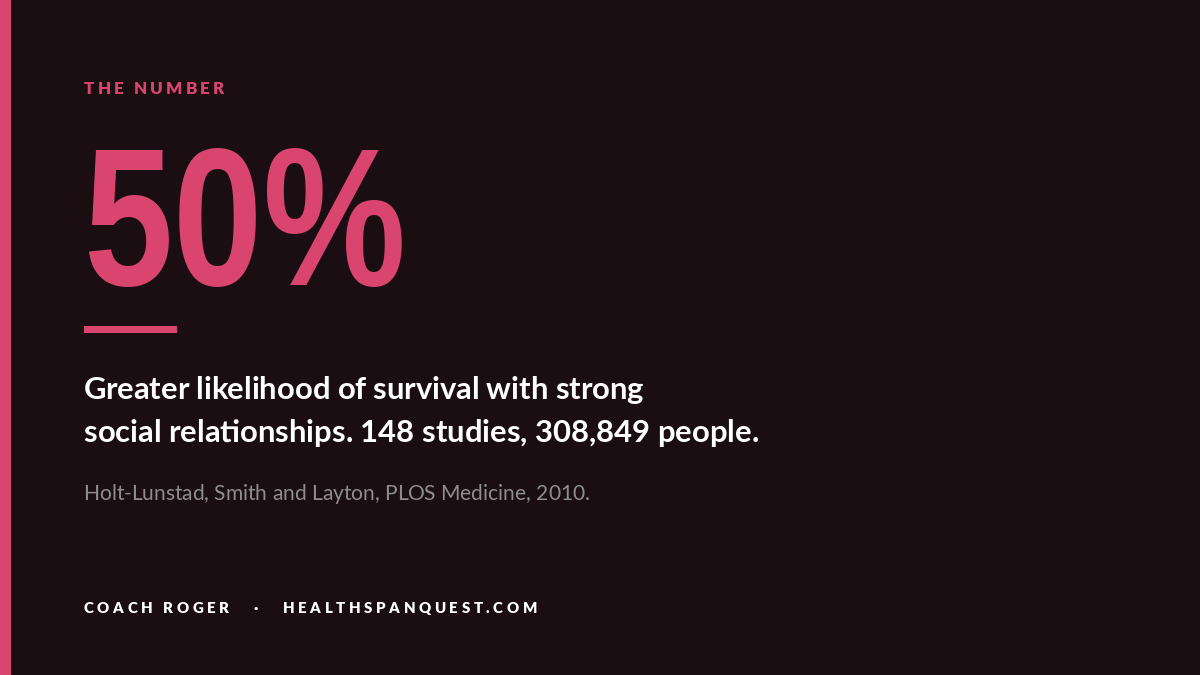
Holt-Lunstad, Smith, and Layton pooled 148 studies covering 308,849 people and published the result in PLOS Medicine in July 2010. Average follow up was seven and a half years.
People with strong social relationships had a 50% greater likelihood of survival over the follow up period than people with weak ones (read the paper).
Fifty percent. That is not a wellness finding. That is an effect size in the same weight class as smoking, and larger than the one for obesity or physical inactivity.
The same lab went back at it in 2015 in Perspectives on Psychological Science, this time pooling 70 studies and more than 3.4 million people. Social isolation raised the odds of dying during follow up by about 29%. Living alone raised them by about 32%. Loneliness, the felt experience rather than the objective count, raised them by about 26%.
When the Surgeon General issued the advisory on this in 2023, the comparison he used was smoking up to 15 cigarettes a day.
You would not tolerate a 15-a-day habit in your protocol. You have been tolerating its equivalent for years because it does not look like a habit. It looks like being busy.
The Part Where I Have To Correct The Draft
I had a line queued up for this article that said the 2018 Cigna loneliness index found the worst rates in working professionals aged 40 to 60.
I went back to check the number before publishing. It is wrong. Cigna's loneliest group was the youngest one, not the middle-aged one. I had been repeating a version of that study that flattered my audience and I had never verified it.
So here is the accurate version, which is less dramatic and more useful. Professionals in their forties and fifties are not the loneliest people in America. What they are is the group with the widest gap between how connected they look and how connected they are. Full calendar, full contact list, and four people who could name what is actually going on in their life.
That gap is the thing. Not the raw loneliness score.
What You Have Is Not What You Think You Have
Count your relationships honestly for a second.
You have colleagues. Clients. People you see at the gym and nod to. A group chat from a trip in 2019. Neighbors whose kids you know by name and whose marriages you know nothing about.
Now count the other category. Friends you have had for twenty years. People you could call on a Tuesday at 2pm for no reason at all. People who know the version of you that existed before the title.
For most men over 45 I work with, the first list is long and the second one has shrunk to two or three, sometimes zero, and almost always without a single decision being made to let it happen.
Nobody ends a twenty year friendship. It just stops getting maintained, the way a truck you stop driving stops running. No failure event. No repair bill. It simply will not turn over the day you need it.
You're not declining. You're under-optimized, and this is the under-optimization with the largest effect size on the list.
Why The Body Cares Who You Eat Dinner With
Inflammation. Chronic social isolation shows up in the blood. Elevated IL-6, elevated CRP, and the pattern is persistent rather than acute. Those are the same markers that drive the cardiovascular and metabolic aging signatures covered in the chronic stress piece. Your immune system reads isolation as a threat state and never fully stands down.
Cortisol and oxytocin. Real connection drives oxytocin, which pulls cortisol down and lets the parasympathetic system take over. This is the same machinery that governs recovery from training, which is why rest days actually work. A lonely nervous system is a nervous system that never gets to downshift.
Blood pressure and heart rate variability. Strong social ties track with lower resting blood pressure and better HRV. Not by a trivial margin either.
Cognitive protection. Social engagement is one of the most consistent protective factors against age-related cognitive decline in the entire literature. Conversation is a load-bearing cognitive task. You are tracking another mind in real time, reading tone, holding context, and adjusting. There is no app that replicates that load.
Think of it the way I used to think about an engine that sat all winter. Nothing broke. Nothing wore out. It just seized, because the thing was designed to run and you stopped running it.
Your social system is the same piece of equipment.
The Harvard Study Nobody Finishes Reading
In 1938 Harvard started following 724 men. Sophomores from the college and boys from the poorest neighborhoods in Boston. They tracked them through careers, wars, marriages, divorces, and deaths, and they are still following the descendants now. It is the longest running study of adult life anyone has.
Robert Waldinger, its fourth director, has said the clearest finding in eighty years of data is that the quality of your relationships at 50 predicted your physical health at 80 better than your cholesterol did.
Not happiness at 80. Physical health.
I have read the summaries of that study a dozen times and I still find it slightly hard to believe, which is probably the correct reaction to any finding that large.
The Friendships I Almost Let Die
Mid-forties, I was in the worst stretch of it. Forty pounds over, sleep apnea, a full-time job on heavy equipment and kids in the house.
My line to myself was that I would reconnect with people after this season. After the project. After the kids got older. After the numbers steadied out.
The seasons kept ending. A new one started every time. Guys I had known since my twenties, guys who had helped me move and sat with me after the surgery, drifted into the "we should catch up" file, which is where friendships go to quietly expire. I did not notice the cost. I was busy noticing the work.
When I finally started rebuilding my health, I ran every pillar hard except this one, because this one had no protocol, no wearable, and no supplement. It took me about two years to admit that I was doing nine tenths of the job and calling it done.
So I started making calls. Ridiculous, inefficient phone calls to men who were surprised to hear from me. Lunches that cost me two productive hours. A standing Thursday thing that I have now not missed in a long time.
None of it showed up on a wearable. All of it showed up in my sleep and my mood, and I could not attribute those changes to anything else I had changed, because I had not changed anything else.
I didn't accept decline as inevitable. I designed my way out of it. This was the piece I nearly designed around.
Okay, So What Do You Actually Do
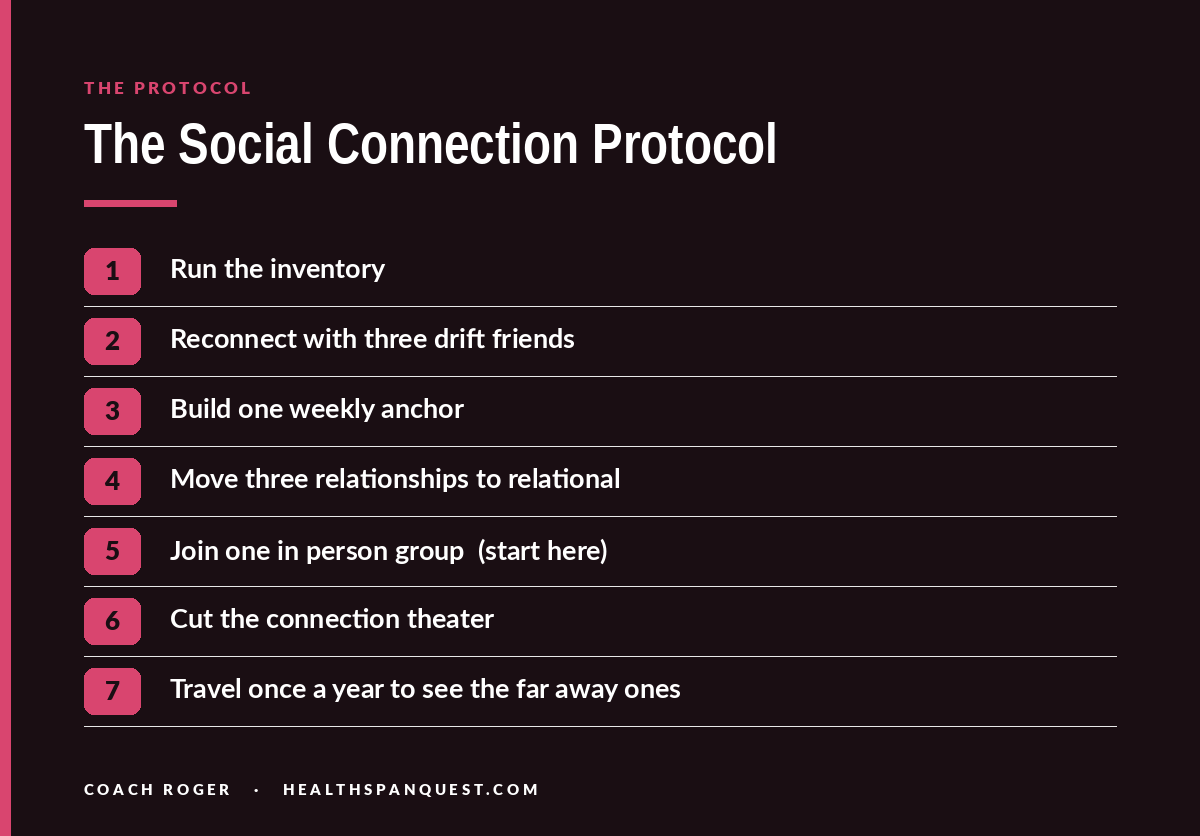
1. Run the inventory. Write down the ten most important non-family relationships in your life. Next to each one, the date of the last real contact. Not a like, not a birthday comment. A conversation. Most guys do this and go quiet for a minute. You cannot fix what you have not looked at.
2. Reconnect with three drift friends this month. Not the ones you fell out with. The ones you lost to inattention, which is almost all of them. Send the text. "Been thinking about you. How are you?" That is the whole message. These rebuild faster than you expect because the foundation never actually left.
3. Build one weekly anchor. A standing call, dinner, walk, or game night with someone outside your household. Same day, same time, every week. Consistency is what builds depth. Sporadic catch-ups do not compound, and compounding is the entire mechanism here.
4. Move three relationships from transactional to relational. Most of your friendships are organized around an activity. Golf, work, kids' sports. Layer in the other thing: what you have been chewing on, what is not working, what you are scared of. Uncomfortable. Also the only thing that actually builds depth.
5. Join one structured group that meets in person. A men's group, a church, a volunteer commitment, a league, a board. Regular rhythm, same people, over time. This is the single highest-leverage item on the list for anyone starting near zero, because it manufactures repetition without requiring you to organize anything.
6. Cut the connection theater. Group texts, comment threads, the scroll. It looks like connection and does not deliver the biological signal. The forty minutes you would have spent on it is a phone call with one real person instead.
7. Travel deliberately once a year to see the far-away ones. Long-distance friendships die from neglect, not distance. Book the trip specifically to see people, not to see a place with people incidentally nearby. Small cost. Enormous compounding over thirty years.
Item 5 is the one to start with if you only start with one. Everything else on this list requires you to initiate every single time. A structured group does the initiating for you, and a protocol that survives your worst week is worth more than a protocol that depends on your best one. That same principle is why scheduled mental recovery beats the version you do when you feel like it.
What Gets In The Way
The time math. Professionals over 40 believe they do not have time for friendship. The math feels airtight and the conclusion is still wrong. Thirty minutes a week is not a cost against your schedule, it is a deposit against thirty years of biological aging debt that otherwise comes due all at once, usually in your sixties, usually right after the career that justified the neglect has ended.
The awkwardness of the first message. After four years of silence, reaching out feels like it requires a reason. It does not. The person on the other end is, in my experience, almost universally glad to hear from you, and the awkwardness dissolves about nine seconds after you press send.
And the waiting. This hits men harder, statistically and in my practice. The men who still have friends at 70 are the ones who kept picking up the phone first for forty years without keeping score. The ones who waited to be called drifted, year over year, until there was nobody left to wait on.
Which is a sad way to run a life and an expensive way to run a body.
Where I Am Not Sure
Whether it is the connection or the life that comes with it.
Steptoe and colleagues ran about 6,500 older adults from the English Longitudinal Study of Ageing and published in PNAS in 2013. Objective social isolation predicted mortality. Subjective loneliness mostly stopped predicting it once they adjusted for demographics and baseline health. Those two findings do not point the same direction, and anyone telling you the loneliness literature is settled has not read enough of it.
There is also the obvious confound. People with rich social lives tend to have money, mobility, health, and the energy to maintain friendships. Social connection may partly be a marker of a life that is already going well rather than the thing making it go well.
What survives that objection, for me, is the mechanistic work. The inflammatory markers move. The cortisol and oxytocin machinery is real and measurable. The effect shows up across cultures, decades, and study designs that do not share the same biases.
So I act on it, and I will tell you plainly that I hold this one with less certainty than I hold sleep or strength training. I am watching the intervention trials, which are still thin.
What I will say without hedging: the wellness industry's near-total silence on this, in an era when it will sell you a $400 ring to track your readiness, is a tell. There is no margin in telling a man to go call his friend from college.
A proven system built by someone who did it himself. No fads. No guesswork.
Take This Further
If you have optimized everything else and this is the gap, book a free consultation and we will look at what your actual week is doing to your nervous system. If you want this built into a coordinated six month reset across all ten pillars, Healthspan Mastery is the right scope. And if you want the nutrient floor that supports nervous system regulation dialed in alongside the relational work, the free 101 Anti-Aging Nutrients guide covers it, with the deeper version of that problem in why a multivitamin is not enough. The strength side of the same program is in muscle as the organ of longevity.
Make The Call
The body you want at 70 is not being built only by what you eat, lift, sleep, and swallow. It is being built by who is at the table, who picks up when you ring, and who knows the real version of you well enough to notice when something is off.
You cannot bottle this one. No wearable scores it. No protocol shortcuts it. It gets built slowly, in person, over years, with people you let close enough to actually matter.
Don't let your birth year write your story. And don't let your calendar write it either.
Make the calls. Book the dinners. Show up on the Thursday you do not feel like it.
Build a Healthspan worth living. Not just a Lifespan you count.
